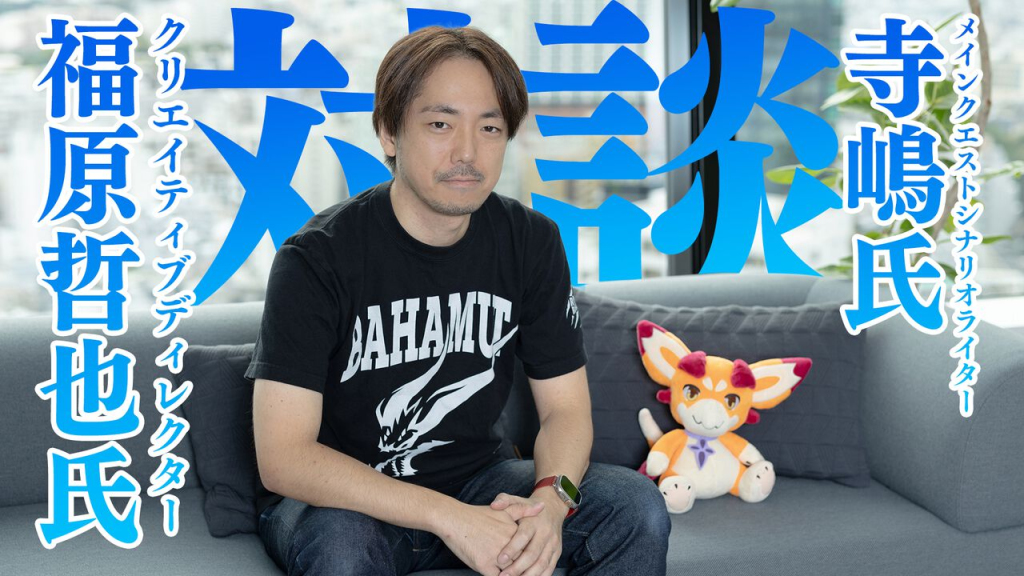
(on December 12, 2025, Famitsu posted an interview with Granblue Fantasy creative director Fukuhara Tetsuya (FKHR) and main quest writer Terashima. This was after the end of the Estalucia arc and before Earth-Sky Oath began.
Still working hard after the end of the Estalucia arc?!
Famitsu: Let’s start off this interview by having you each introduce yourselves and what you do for GBF.
FKHR: GBF started as a team of 5, including myself and the producer Kimura Yuito. We split the work into battle lead, party system lead, and so on. I was in charge of quests and dialogue. We finished the alpha in about 3 months, and once we got corporate approval to continue development, they made me director after I’d spent a lot of time helping in other aspects of the work. After the game was released, I oversaw GBF content both internally and externally.
Famitsu: In 2024, they announced that your title was now Creative Director, did anything about your work change?
FKHR: Starting in 2016, development of Granblue Fantasy: Relink (Relink) and Granblue Fantasy Versus (GBVS) started in parallel to the original browser game, so I was overseeing 3 titles worth of development at the same time. They felt like I was the only one who could keep the games all consistent with the same setting and materials, so I have stayed on that job since. I’ve handed off most of the in-office development and operations to the producer and a few others, and I help out on the story, art, and concepts while working on a few other development projects.
Terashima: I have not been with GBF since its launch. I was working on a project that was shut down, then transferred to the GBF team while it was still in early development. After a while, I was put in charge of the story. Only two of the main story parts have been written by other people since I took over, I’ve been lead on the rest.
FKHR: It was pretty early in the life of the project.
Terashima: I was pretty surprised, I thought that the title was going to be some kind of other IP’s project but it turned out to be a new franchise entirely (laughs)
Famitsu: The Estalucia arc ended in October 2025, do you have any thoughts about the story when you look back at 12 years of its development?
FKHR: Time really does fly. From running the game to developing its spinoffs and working on external events and projects, the game has kept me very busy in a good way. I haven’t had any time to look back on it. When we have internal gatherings or when we look at pictures of Granblue Fes, I think “the staff and I look so young…” and I get shocked (laughs)
Terashima: I don’t feel like 12 years have passed either. There wasn’t any moment to celebrate and go “We’re done!” so it just feels like I blinked and here we are.
FKHR: We have a few staff who’ve been with us from the beginning, Terashima included. It feels like we’ve all been running a race together for years.
Terashima: Because we hit a big turning point, we really needed to make sure that our players weren’t left with a bad taste in their mouths, and instead think “this next part will be fun!”
Famitsu: In the climax of the “Wayfaring Astral” arc, the crew arrived in Estalucia and learned so many secrets of the GBF world. Were all of these secrets to the setting part of the idea from the very beginning?
FKHR: I don’t remember exactly how many years ago this was, but we had Lyria and Vyrn’s back stories set fairly early.
Terashima: I know that when I joined the team, they hadn’t set it down yet. Around the 2nd or 3rd anniversary, we wanted to make sure we could prepare for that goal whenever we needed to get there, so that’s around when we nailed down the details about Lyria and Vyrn.
FKHR: We haven’t covered a lot of that material in the main story, but we had the foundation of it set so that we could be consistent about it and have it be coherent as more and more of it surfaced.
Terashima: I wondered recently if I have my materials from back when we were working on that, and I found it in my desk. This was what it looked like up to “Dawning Sky”.
Famitsu: That’s a huge file!
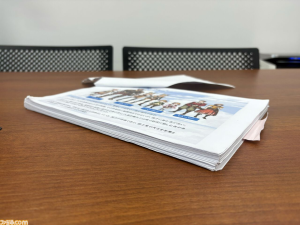
Terashima: Our info about the Creator is set in these files. Although a few things in here make me go “Hmm? That’s not true anymore” (laughs)
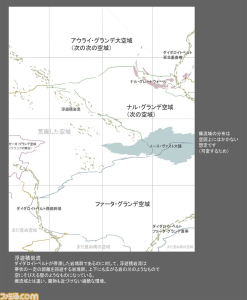
FKHR: We’ve made several more documents like this for the setting and direction. We haven’t shared these very often, but early in the game we did things like draw out the Oarlygrande skydom map, and try to map out the entirety of Auguste.
Designing the MC’s parents
Famitsu: Did you decide pretty early on that Lyria and Vyrn’s secrets would be revealed at the end of this main story arc?
FKHR: We knew that we were going to end in Estalucia, but we didn’t set anything up to there in stone. But Vyrn and Lyria’s origins are pretty sensational, so we figured that we would save those for the very end.
Terashima: That said, GBF‘s story events and the stories attached to other content have many reveals tied to them… hopefully the ending of “Wayfaring Astral” tied up a lot of those hanging threads. I feel like at one point, we wanted to set it so you couldn’t make it to Estalucia without clearing every event quest.
FKHR: It was a plan born of the thought that no matter how many characters a skyfarer had met or what order they had read the story events in, Estalucia would be where every player’s journey converged. We thought it up a very long time ago, but we canned it after we saw how much work and stress it would be for the players.
Famitsu: Was Gallanth’s appearance in Estalucia all according to plan?
Terashima: The story starts with wanting to meet your father, and the letter says “meet me in Estalucia”. I think we had to do it that way.
FKHR: We started talking about making it to Estalucia around the 5th or 6th anniversary, and we started talking about how many updates it would take to make it there before just before the 7th anniversary. I personally wanted it to be around the 10th year, but circumstances made it take until year 11. Gallanth’s visual design was finalized right as we finalized the script, so it ended up coming down to the wire there.
Terashima: True, Gallanth’s design was designed afterward, and we barely made it (laughs). My request to the artist was “Make someone similar to the male MC, and put glasses on him.” There have been multiple instances in the story where someone says that the MC resembles their father.
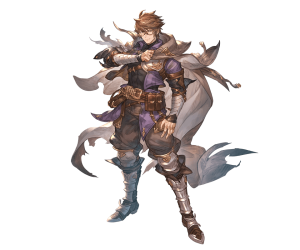
Famitsu: Is that resemblance one of the major reasons you put glasses on him in the first place?
Terashima: That’s part of it, but the biggest reason is that glasses are an easy way to visually establish a character as being older.
FKHR: We spent a lot of time tinkering with his face. How many wrinkles should he have, should he have any facial hair, stuff like that. We looked at differentiating his color palette from the male MC, and in the end we used a subdued purple that went right between the male and female MC’s colors.
Famitsu: Quite a few skyfarers were surprised that Ono Yuuki, the voice of Gran, was also cast as the voice of Gallanth.
FKHR: While we were thinking of who to cast in the role, the idea “Why not Ono-san?” popped into my head. Ono-san played Gran in the anime and in the console games, but in GBF the main character doesn’t have voiced lines in the story. I worried that casting Ono-san as Gallanth would seem like a 4th wall breaking casting gag when he already has so many other miscellaneous roles in the game.
Famitsu: Ah…
FKHR: So before we settled anything, I wanted to ask Ono-san himself what he thought. After a GBVSR recording session, I explained the situation to him and asked him if he would be willing to record a few lines as if this were an audition. He agreed to it on the spot and when I brought the recordings back to the team, everyone agreed that he sounded exactly the way we wanted the character to sound.
Terashima: Our concept for Gallanth was “super strong dad”, and the test lines that Ono-san gave us were perfect for it.
FKHR: We thought that we would have to lower the pitch a bit from Gran, but that would end up sounding a bit too much like Lancelot if that’s all he did. But that’s the power of his acting. As we got more and more voices from him, he really got a feel for the character and strengthened that connection to him.
Famitsu: The battle animations for Gallanth really make him feel like a wild man, was this your idea too?
Terashima: Yeah, we thought that since this game has the main character equip so many weapons, we should do the opposite of that and have Gallanth fight with his bare hands. We slid a note into his back story that he learned how to fight from the granny back at Zinkenstill, so we used a lot of granny’s powerful animations when working on him.
FKHR: But if we’d given him granny’s exact stance and animations, it would seem more comedic than mighty, so we made a few adjustments that hopefully made him look a little cooler.
Famitsu: On the other end, Rein appeared in Granblue Fantasy Versus Rising (GBVSR) before she appeared in the main game, and we learned a lot about her there. I think many players were surprised by her identity.
FKHR: GBVS had the time-honored fighting game story of fighting most of the cast until you fought the real bad guy Beelzebub at the end. It was good enough for a first try, but we had to expand on that story for GBVSR. “Let’s go beat up Lucilius next!” didn’t really have much in the way of fun or excitement to it, so we thought that we could use a big surprise like Beelzebub in the previous game. So we had the offensive goal of defeating Lucilius, and on the defensive side we wanted a mysterious character who had to be protected by the main cast to add some depth and surprise to the story.
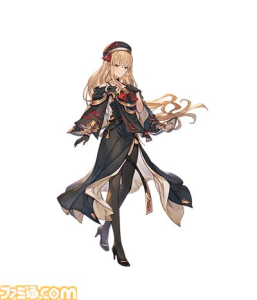
Famitsu: Rein not looking at all like Gran or Djeeta must have added to the surprise.
FKHR: We wanted the reveal to be a surprise, so we wanted to make sure no one figured it out before the game came out. It’s natural for parents and children to share hair color, so I’m glad that in the main story of GBF we see Rein with her natural hair color, which is the same color as the female MC.
Separating the main characters from their crew was necessary to focus the story
Famitsu: In the climax of “Wayfaring Astral”, many events separated the crew from you member by member. Was this planned far in advance?
FKHR: Terashima and I had talked about how, when it came time to learn the secrets of the world, it would be down to the MC, Vyrn, and Lyria. It would be too messy if the drama didn’t center around these 3.
Terashima: I remember really thinking hard about how to separate the crew from the main characters. When I thought about how to flow from the defeat of the Otherworld to the arrival in Estalucia, that’s where we ended up. Also, with the story being about family, I didn’t want the story to be about how the family of the crew compared to Gallanth, your birth father. Both are precious family, so I wanted to narrow the focus to the MC, Lyria, and Vyrn at the end.
Famitsu: So if the main character brought a crew of friends to the reunion with Gallanth, that would have muddied the main theme of the story?
Terashima: Yes. I felt sad that I couldn’t write the MC introducing the closely knit crew they’d gathered over the journey to Gallanth… But for example, if Eugen had been there it would be strange if he didn’t offer his thoughts on how he viewed Gallanth as a fellow father, and since Rosetta had traveled with Gallanth before it would have needed its own scenes. Each character brought their own similar elements to the story, so that would blur the focus too much if they weren’t somewhere else at the time.
FKHR: We thought long and hard about if we should write in the deaths of the crew. Up to that point in GBF story, characters who died had not come back. The story happening in Estalucia, the land of the afterlife, allowed us to shake up the world and arrive at this ending.
Terashima: I still wonder if we could have written it differently.
Famitsu: In the climax of “Wayfaring Astral”, the MC and Lyria master the innermost teachings, how did you get to that point?
Terashima: Fukuhara and the other writing team members lay out the story outline with me: when we should have a climactic battle, when we should have our most thrilling moments, and so on. During those discussions, one of the planners sad “This is a big point in the story, do you think we can make it an even bigger moment?” That’s how we got to the point where, in the general flow of the story, we would have the MC and Lyria master the innermost teachings. We didn’t plan it from the start.
GBF and its lack of truly evil villains
Famitsu: GBF is known for its very unique and memorable villains. Which villain from the main story do you think was the most memorable?
FKHR: I don’t know if I can call him a villain, but the True King Tau’luk was memorable to me.
Terashima: He was pretty enigmatic.
FKHR: I was surprised when people started sympathizing with him a lot after he abdicated his position as True King. So many of them had called him names and hated him before that (laughs)
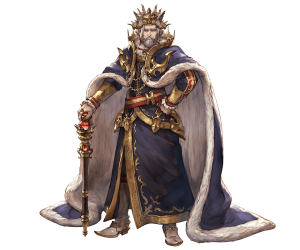
Famitsu: He’d done things like kidnap the MC’s aunt Partita (the priestess of destruction), so it was easy to hate him.
Terashima: He also treated his daughters (Alliah and Pholia) terribly. But in the end, people started to understand his motivations and why he did these things.
FKHR: I think he developed into a much more fun character after his introduction.
Terashima: As for other favorites… definitely Loki for me. He was part of the story since the Girl in Blue arc, and we were able to send him off at the end of “Wayfaring Astral”. The Wayfaring Astral was Loki himself, and I’m glad we were able to give him such a big role.
We can’t talk about memorable villains without mentioning Pommern, either. Somewhere in the story he started seeming like a stand-up guy, but he did murder the MC at one point (laughs).
FKHR: He’s become so popular since doing such awful things in the tutorial, so we were a little confused on how we should treat him in the first season of the Granblue Fantasy anime. I think that the egg gag in Grand Blues! 52 was the turning point where people started liking him (laughs).
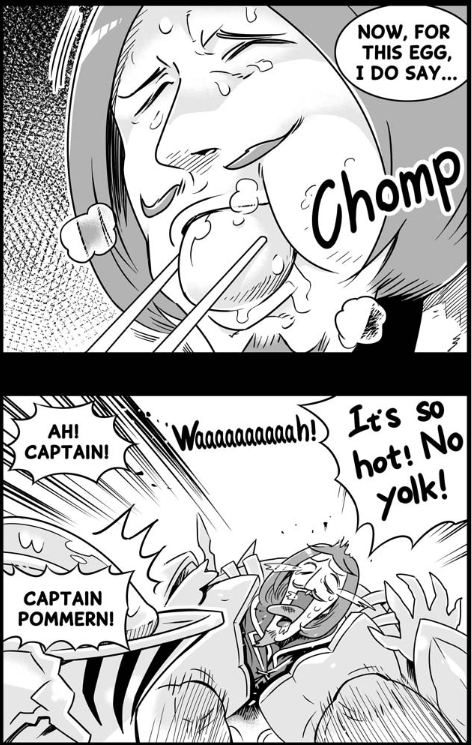
Terashima: I was pretty surprised when he got his own spinoff comic. When I heard that GBF was going to get a spinoff I was happy, and then when I found out the story I went “Wait, Pommern?” and was more shocked than happy (laughs).
FKHR: I think it was the comic editor who suggested it.
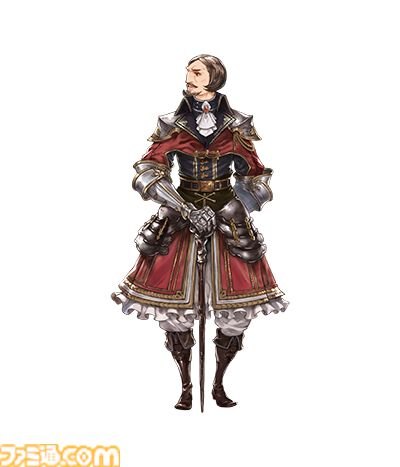
Famitsu: The more we talk about it, the more we think that GBF has lot of villains you just can’t hate.
Terashima: From the True King to Loki to Pommern, you find out that there are things that they are willing to go to any length to protect, which is far from evil for the sake of evil. Even some of the invaders from another world feel forced to do so because their own world is dying. The Otherworld are victims as well.
FKHR: When you include the story events, GBF has a lot of factions, and none of them are monolithic in their motivations. They all have their own circumstances and beliefs, and it’s honestly hard to make purely evil characters. Beelzebub was made for a fighting game, so he was made to be a pretty nasty character, though (laughs).
Terashima: I think the most villainous character we’ve written might be Gilbert. His upbringing was a little twisted, but he’s one of the rare cases in the game where he’s working purely for his own gain.
FKHR: I think out of the recent villains, Demiurge (Repti) was good, too. He was Terashima’s brainchild, but after the Estalucia arc he became one of my favorites.
Terashima: I felt like I wanted someone who was there at the beginning of the journey to be there at the end, so I wondered “Who delivered that letter in the first place?” and he was born from there. It’s not like Estalucia has a post office, so it had to have been something major.
I originally wanted one of Demiurge’s creations to be the final challenge, but in the end I had him take on the MC himself. With Ishida Akira-san to give him life, and his look and personality, I thought it would add an extra level of edge to the scene (laughs).
FKHR: He’s so different from Ishida Akira-san’s other character in GBF, Sariel. When it came to his visual design, his Repti look made him seem like a jester, so we came up with a whole new look for him when he appeared at the end of the Estalucia story.
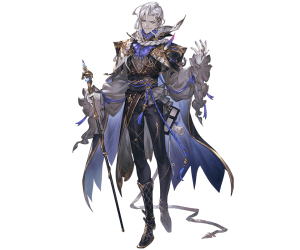
The concept of the Astrals: people who were not cast out from paradise
Famitsu: From the MC and Gallanth to Eugen and the Black Knight Apollonia to a few other examples, there are several parent-child relationships that have been a major focus of the story. Was that always part of the plan?
FKHR: When I was in grade school, I played Dragon Quest V: Hand of the Heavenly Bride and the ability to live someone else’s life vicariously made a huge impression on me. After it, I started loving stories that involved parents and their children. Games allow you to write stories that take place over long periods of time, and I wanted to do that myself. However, with the realities of GBF as a service game, it’s hard to write stories about the passage of time or generational changes. I suppose you could say that these family dramas are a bit of a response to that. Also, I think that as you add more characters, more and more similarities inevitably start to pop up.
Terashima: Personally, I did make sure that some of it was in there. For example, the relationship between Demiurge and Gallanth comes from the Greek tragedy Oedipus, and the Oedipus complex that takes its name from the myth. On top of that, I wanted to ask what it meant to mature and grow older, too. Getting a bit academic, GBF‘s main theme is “the journey”. What that journey is, well, maybe it’s the journey to maturity. And in that process of maturation, you naturally end up following your parents’ path, and maybe surpass them. The easy examples would be the MC and Gallanth, or Lecia and Walfrid, who are both following in the footsteps of famous fathers.
Famitsu: Interesting.
Terashima: And the relationship between a parent and a child isn’t always easy. The True King and Pholia’s story has her rebel against a father who used her as a tool, while Mikaboshi and Shitori’s story includes being grateful to a parent while being very aware of their flaws and mistakes, and feeling responsible for cleaning up after them. There are so many different relationships in GBF.
FKHR: This is a bit meta, but stepping into messy family problems as an outsider makes fertile ground for a complex and deep story. The nature of a family bond is very different from a friend or comrade.
Terashima: On top of that, being a social game we have to write relationships that involve the main character, but it’s very difficult to write a romantic relationship for them. It would land very poorly if the main character of our adventure was not also cut out to be a romantic lead.
We do have characters like Leona, whose fiancée died, and as the story went on, we had more variation in their relationships by volume.
Famitsu: That was Abel, right? In the “Dawning Sky” arc you had brothers named Cain and Abel, whose names come from the Old Testament of the Bible. There are tons of cases in GBF where the characters owe their story to the myth or legend that their names come from.
FKHR: Yes, I believe Abel’s backstory was steeped in Terashima’s tastes.
Terashima: It was absolutely one of mine (laughs). GBF‘s Cain isn’t guilty of anything close to what his namesake did, but because of the guilt he bears over his brother’s fate I named the two of them after the biblical brothers.
When I write the story of GBF, I know that it’s a fantasy tale but these aren’t aliens that I’m writing. I don’t just take the names from mythology, I use the motivations and stories from history and mythology to drive their logic.
Famitsu: When you compare skydwellers to the Astrals, the Astrals do feel kind of alien.
Terashima: In the Old Testament, Adam and Eve were cast out from the garden of Eden for eating the fruit of forbidden knowledge, and the Astrals were what came from a thought: what if there were people who had not eaten the fruit and stayed in paradise?
They might grow proud with how much they were born with and gifted with, and look down on the people who had been cast out… that was my idea, at least.
FKHR: Our first Astral in the story was Loki, right? I think he showed up in our first Christmas event threatening Santa Claus before he showed up in the main story (laughs)
Terashima: That’s right! (laughs)
FKHR: I remember making it a point of emphasis that Loki’s way of thinking was inscrutable and enigmatic.
Terashima: I don’t like foreshadowing anything without paying it off later, so I am glad that I was able to finish Loki’s arc in the main story. He spent a lot of his time aimless and wandering, and I gave a lot of thought to where he would end up.
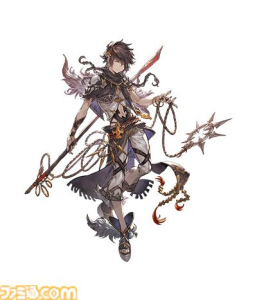
Famitsu: Did you think he’d get scolded by Byleistr in Estalucia at the end (laughs)
Terashima: (Laughs). People like to say that GBF is full of deadbeat dads and that’s true in its own way, but Byleistr was a great father who put his daughter’s (Orchis’) wellbeing first. He’s a foil for Gallanth, who left his child to tough it out on their own so he could save his wife… I don’t mean to make a judgement about either of them as the better or worse parent, it’s simply a difference in their priorities.
Famitsu: Loki and Fenrir’s relationship was really memorable, too.
Terashima: Just like the Norse myths that gave him his name, GBF‘s Loki is a trickster with somewhat nebulous motivations, while in the Norse myths Fenrir killed Odin, so giving her the ability to kill gods felt natural.
FKHR: Fenrir originally came from Rage of Bahamut‘s cast in that same star system I mentioned before. She had skills that made her especially powerful against Odin, while in GBF she had a big role as a trump card against the Otherworld after they took over the Creator god’s remnant.
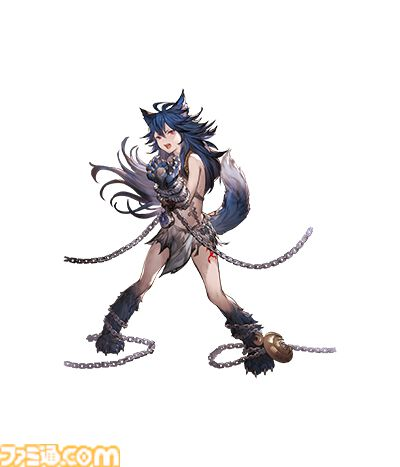
Famitsu: I feel like she had the biggest role out of all of Loki’s crew.
Terashima: When we were setting up Loki to be a foil to the MC, it felt natural for him to form his own crew. We didn’t want to create a bunch of new characters to make that crew, so we wanted to gather up characters whose major role in the main story had already passed.
We didn’t want every single character on that crew to come from that pool, though, so we created Necesaria as a fresh character. He made a powerful impact as well.
Famitsu: Do you have any plans to use characters whose role in the story ended with the Estalucia arc? Loki’s crew members included.
FKHR: We don’t know everything that will happen in the future, but that’s possible.
Terashima: My motto is “Nothing is impossible in the story”, so I have my own personal hopes for it.
FKHR: There were a lot of one-shot characters like Raclitus and Guillota in the Wayfaring Astral arc, so I’d love to have them come back somehow. I’d also like to bring in characters from Relink and other GBF media.
The looming presence of the Nahle Great Wall
Famitsu: Tell us some behind the scenes stories about the Girl in Blue and Dawning Sky arcs.
Terashima: When I joined the project, the story had gone up to the Lumacie Archipelago (translator’s note: chapters 13+), and I was surprised to see that Orchis (Orchid) from Rage of Bahamut wasn’t a ball joint doll anymore.
FKHR: We had orders from the company that they wanted to see characters from Rage of Bahamut‘s cast in GBF as well in a so-called “Hollywood star system”, so we added several of them to the main story cast.
However, they also wanted some differences between each franchise’s version of the character, like making Monika look different or changing Orchis so she wasn’t a ball joint doll anymore. After a while that rule went away (laughs)
The story from Dawning Sky that I remember the most is when we started the new arc, we wanted to give the new skydom a more oriental look, from its cities to its fields and mountains. This required a huge amount of prep work, and the background team saved our hides.
Terashima: The architecture changes so much between Phantagrande and Nahlegrande.
FKHR: We had a Western look at first, and then tried to do a huge visual shift, from the clouds on the world map to the climate and the look of the sky. We showed these new Nahlegrande visuals to our composer Narita Tsutomu-san when he was composing the new music and themes.
Terashima: With the setting switching to more Asian imagery, I remember adding many more Asian names and designs.
FKHR: I wanted to have a Nahle Great Wall.
Terashima: I remember that (laughs)
FKHR: The Nahle Great Wall came about because we wanted an instantly recognizable landmark that made you aware that you were in a new environment, something that really cut a figure across the normally clear blue sky.
We took some names from celestial structures as well, to show the main characters that there were many things beyond their understanding in the world. For example, the Dydroit Belt was inspired by an asteroid belt.
Terashima: And if we made that structure, we had to explain why it was there in the story (laughs). In the real world, there are rumors of a satellite that shoots metal rods from space nicknamed “rods from God”, and that’s what we had as Nahlegrande’s reality: divine punishment that rains down from on high.
Famitsu: In the course of a nearly 12-year project, were there any adjustments you had to make to the story to suit changing times?
Terashima: In the beginning, the concept was “make it a story that will never end”, and so that’s why we made stories that began and ended on each island without truly connecting to a larger story. When we made Estalucia the ultimate destination of the journey, we had to adjust for that.
FKHR: Back in 2013 or 2014, it was important to give off that “never-ending story” vibe… but around 2017, the trend for social games changed and even social games were celebrated for bigger stories with clearer milestones and endings. I think that was the biggest shift we felt from changing times.
Terashima: We’ve had a lot of big changes in how our animations and effects work in these 12 years, as well. In our more recent stories, we’ve had more and more art that isn’t just the characters’ standing sprites. I think our first one of those was Vira holding Katalina during the fall of Albion, and we started using the art regularly in commercials and other places. The first arc that I wrote from the beginning was the Albion arc, so I remember that part clearly.
Famitsu: Vira is still a very popular character to this day.
FKHR: We didn’t really expect that. Our design process for Vira went through almost no changes. We took the light out of her eyes in her original art, and her smile was very dangerous the whole time, which was another factor in her popularity.
Terashima: She has some crazy in her character, but as long as Katalina isn’t involved she is sensible in her relationships and her work as the Lord Commander of Albion. As our cast grows and we’ve made even crazier characters, she seems so very normal now (laughs)
I still regret not being able to write a reunion between her and Katalina at the end of the Estalucia arc.
FKHR: We had to keep the story to a certain length, and we couldn’t help but leave it out.
Embarking on a new journey with new crew members!
Famitsu: You’ve announced that new main story chapters will come out in December. What can you tell us about what’s going to happen?
FKHR: The biggest change is that we’ll have appearances from characters who were previously unconnected to the main story. Way back in “Dawning Sky” we talked internally about how important it was to incorporate characters from story events, but things didn’t line up quite right and we put it off. From here on out, many of the characters from story events will inevitably link to the main story so hopefully that’s exciting.
Terashima: Characters who appeared in the main story will be around in many forms as well, and we’ll be able to go into great detail on what some of those characters are up to.
FKHR: Put another way, characters who previously only appeared in the main story and whose story arcs seemingly closed there will be even easier to integrate into story events and other places.
Famitsu: Going into these new chapters of story, did anything change about the way you write and plan out the story?
FKHR: I’ve stepped back a little bit from the main story, and the future developments will be coming from Terashima and the veteran writers. Doing this will allow new ideas and developments I would never have thought of, and I’m very excited about that.
Terashima: Up to now, I pretty much wrote the main quest under FKHR by myself with his approval, but starting with this new chapter we’ll spread the load out more among the team. We have new team members, as well as many writers who wrote a lot of fun events, so I’m sure it will get even better.
FKHR: The journey to Estalucia may have ended, but that journey only touched a small portion of the sky realm. I hope we can keep enjoying this journey for a very long time.
Terashima: I’m the type of person who checks player reactions directly, and I’ve been able to write for this long because the players have told me when they enjoy the story. I want to thank all of you. GBF is far from over… and seriously, it’s bewildering that after 11 years we are showing no signs of slowing down or stopping.
FKHR: I feel like we can get the Guinness record for number of words and voiced lines in a video game…
Terashima: We certainly have enough material to make a case (laughs). I hope you can enjoy what lies ahead in GBF.
(This interview ended with a preview of the Earth-Sky Oath teaser trailer, so we’ll skip that and move on to the next interview: next up on our translation list, the Denfaminico Gamer interview that kicked off the new story!)